DESTINY
AI-Powered Living Evidence for Climate & Health
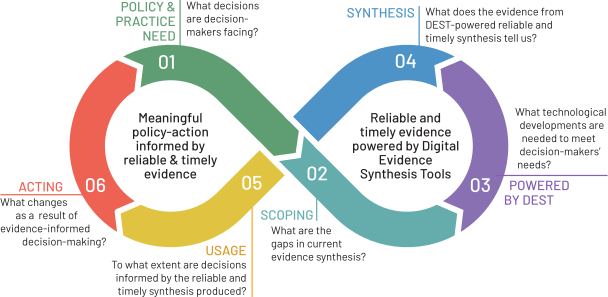
It is our moral obligation to protect people around the world against the climate crisis based on the best and most recent evidence available. This is a Wellcome-funded consortium on a mission to build the next generation of evidence synthesis tools driven by artificial intelligence to deliver rigorous living evidence in climate and health that matters to policymakers and other evidence users.
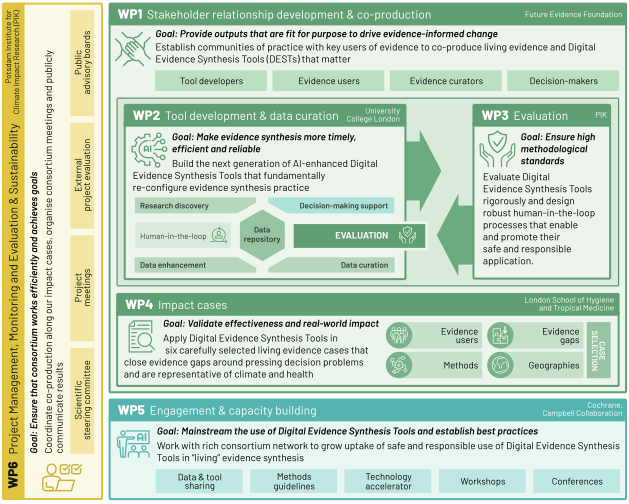
DESTINY (Digitial Evidence Synthesis Tool INnovation for Yielding Improvements in Climate & Health) will co-develop a new generation of digital evidence synthesis tools (DESTs) and showcase their transformational power for the delivery of rigorous living evidence in climate and health that matters to policymakers and other evidence users. This defines who we work with, how we work, and the technology we use to make evidence synthesis dramatically more useful. In particular, our project will:
- Leverage recent AI advances to develop new DESTs, enhancing evidence synthesis by reconfiguring human-machine interactions (WP2);
- Engage in DEST evaluation to design safe and responsible applications without eroding methodological standards (WP3);
- Build communities of practice with decision makers around the globe and across scales to ensure DESTs are fit-for-purpose, work for all and are applied to six impact cases that matter (WP1, WP4); and
- Mainstream use of DESTs and support users, producers, and funders of climate and health evidence synthesis to establish best practices (WP5).
Delivering on real-world user needs
Co-production is at the heart of the project as technology is transformative through its users. We will use the proven Alive (Alliance for Living Evidence) partnership model to ensure DEST development is responsive to the needs of users involved in driving evidence-informed climate and health policy and action. We will convene partnerships between decision makers, advisors, intermediary organisations and evidence synthesis groups, supporting them to work together to identify, synthesise and engage with living evidence for climate and health decision-making. This places evidence users at the centre of tool development, evidence generation, and real-world impact.
This work will be supported by the long-standing relationships with regional and local decision-makers of our consortium members LSHTM, eBASE, ACRES and ASCEND, combined with experience in brokering actionable evidence for impactful decision-making.
Building the next generation of digital evidence synthesis tools (DESTs)
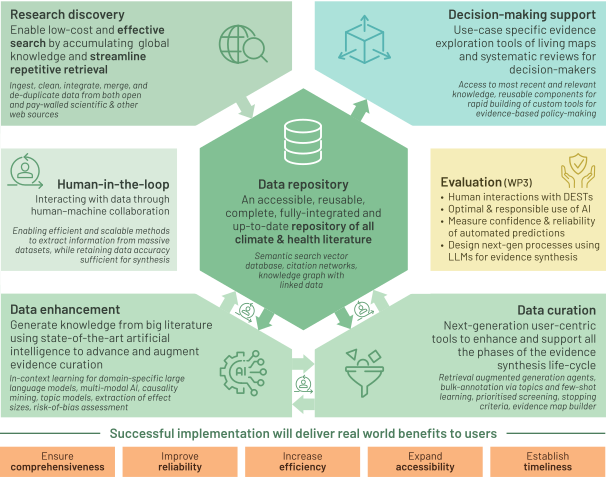
Tool development will be driven by an overriding objective to deliver a step-change in making evidence synthesis faster, cheaper, timelier, and more useful. We will prioritise the automation of complex and resource-intensive tasks, including study discovery, data extraction and harmonisation, critical appraisal, and synthesis. Outputs will be modular, open and FAIR (through APIs, code, and apps) to ensure innovations are shared widely, drive adoption by third party tools and catalyse growth in the research and development of machine learning for evidence synthesis and use.
We will systematically address four key bottlenecks that currently inhibit the production and use of climate and health evidence in decision-making:
- First, bibliographic data are fragmented across many databases. This wastes limited resources constructing, translating and running searches across databases, and deduplicating results. We will create a research discovery service that feeds a living, open data repository based on OpenAlex.
- Second, huge resources are currently devoted to screening records, critical appraisal and data extraction. We will facilitate a step-change in efficiency by building data enhancement services into the repository.
- Third, where data are ambiguous, non-standardised or semantically imprecise, we cannot rely on automation alone to deliver the level of accuracy and interpretation needed for synthesis. We will therefore develop data curation tools and human-in-the-loop workflows to maximise the efficiency of human-machine collaboration for sense-making and data harmonisation.
- Fourth, evidence and communication tools are often not well adapted to the needs of decision makers. We will therefore build and customise decision-making support tools. These will support evidence mapping and exploration, translation, re-analysis, and re-contextualisation by decision makers and their advisors.
Communities of practice for six impact cases
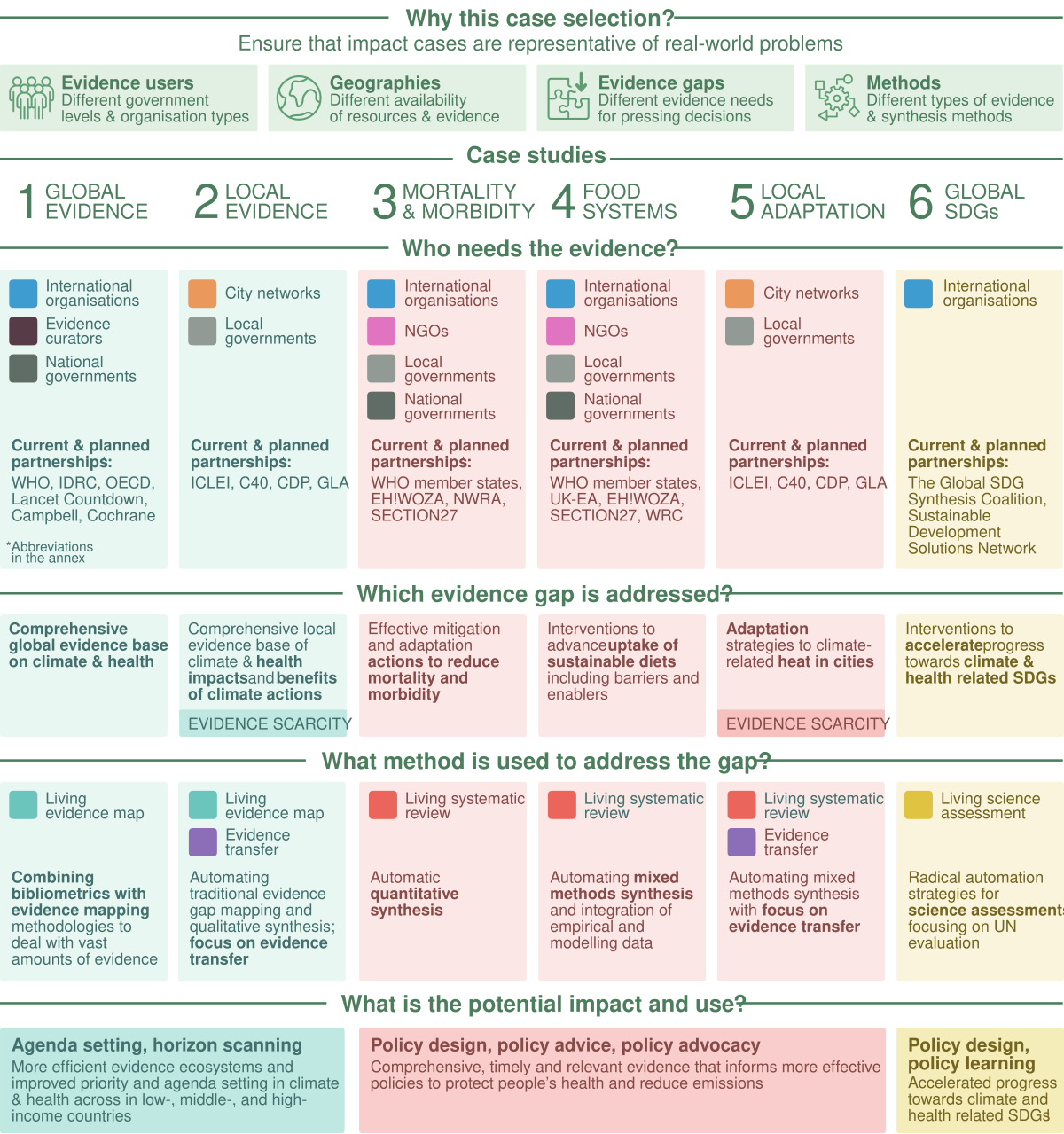
We will safely and responsibly apply DESTs in six Alive communities of practice for living evidence to showcase that DESTs are fit-for-purpose in climate and health, work for diverse users, and deliver real-world impacts.
The first two impact cases will co-create needs-driven living evidence mapping methodologies to improve the effectiveness of the overall evidence ecosystem for knowledge users operating at local to global scales.
- Case 1 will provide the first living, multi-purpose map of the entire evidence-based climate and health literature by combining AI-facilitated content synthesis, data enhancement strategies, and bibliometrics.
- Case 2 will create a living evidence gap map and thematic synthesis of climate-related health impacts and co-benefits of actions in cities by advancing automation of traditional mapping methodologies and transferring evidence to evidence-poor areas.
Impact cases 3–6 will focus on co-producing rigorous living systematic reviews that enable fast evidence-based decision-making for reaping health co-benefits of climate actions.
- Case 3 will demonstrate a living quantitative synthesis addressing the lack of comparative evidence on impacts on human mortality and morbidity of various climate change mitigation and adaptation responses, using proven methods of data harvesting.
- Case 4 will complement this by demonstrating how to advance automation and scaling in mixed methods synthesis, where human behaviour and uptake of solutions play a key role in success. We will use climate and health actions for sustainable food systems as our core example.
- In case 5 (extension of case 2) we will work with local decision-makers on effective evidence transfers, focusing on transferring knowledge on heat-related mortality and morbidity in cities to evidence-poor settings by combining empirical and modelling evidence.
- In case 6 we will work with the Global SDG Synthesis Coalition to accelerate progress towards climate and health-related SDGs. We will explore radical automation strategies to strengthen large-scale UN-style science assessments, and learn how to work with less standardised, grey literature sources in synthesis.
DESTINY consortium
Our multi-international core team has 45 members from nine institutions who are closely collaborating with partners across more than 30 institutions. The consortium is lead by Jan Minx at PIK.
DESTINY is supported by Wellcome’s Climate and Health programme. Since this project was agreed, Wellcome have announced a new intent to fund an Evidence Synthesis Infrastructure Collaborative which is not specific to climate and health or digital evidence synthesis tools. That announcement is separate from this project. In DESTINY we strive to make valuable contributions to the evidence infrastructure and welcome opportunities to integrate our work with new initiatives supported through this announcement.
A summary of our early thinking on decentralised, open source, open science approaches to sharing of evidence data is here.









Jan Minx
PIK

Max Callaghan
PIK

Diana Danilenko
PIK

Ishita Gopal
PIK

Shona McCulloch
PIK

Maria-Inti Metzendorf
PIK

Kristina Peselyte-Schneider
PIK

Tim Repke
PIK

Julian Elliott
FEF

Ruth Stewart
FEF

Britta Jeppesen
FEF

Andrew Harvey
FEF

Ryan Fitton
FEF

Karla Soares-Weiser
Cochrane

Toby Lasserson
Cochrane

Anna Noel-Storr
Cochrane

Ella Flemyng
Cochrane

Gert van Valkenhoef
Cochrane

Christopher Trisos
Director of ASCEND

Rhona Mijumbi
ACRES

Ismael Kawooya
ACRES

Caroline Nakalema
ACRES

Pauline Scheelbeek
LSHTM

Rosemary Green
LSHTM

Eleanor Darby
LSHTM

Hugh Sharma Waddington
LSHTM

James Thomas
EPPI@UCL

Ailbhe Finnerty
EPPI@UCL

Sergio Graziosi
EPPI@UCL

Lena Schmidt
EPPI@UCL

Kaitlyn Hair
EPPI@UCL

Nadia Soliman
EPPI@UCL

Patrick Okwen
eBASE

Tetamiyaka Kinlabel Tezok
eBASE

Alang Ernest Wung
eBASE

Will Moy
Campbell
Co-applicants marked in bold
Get in touch
Are you interested to learn more, to collaborate, or to work with us? We are looking forward to hear from you!