DESTINY is developing, maintaining and coordinating a portfolio of software tools and services to strengthen the digital infrastructure that supports evidence synthesis. Together, we call these tools the open data infrastructure.
These tools are designed to support different stages of the evidence synthesis life-cycle while promoting transparency, reproducibility, interoperability, and community participation and development.
DESTINY seeks to balance innovation with sustainability by supporting both experimental developments and production-ready services that can be adopted by the broader evidence synthesis community.
Associated projects, such as METIUS, GALENOS and the Education Endowment Foundation project, are co-developing the open data infrastructure and using it to offer evidence repositories on topics other than climate and health, for example, education, mental health, vaccines and crime and justice.
DESTINY is not developing end-to-end evidence synthesis infrastructure. In particular, we will not replace evidence synthesis software products such as Rayyan, Revman, Covidence and EPPI-Reviewer. Instead, open data standards will facilitate full interoperability with these data curation tools. This will allow users to return data enhancements (for example, human-coded labels) to the evidence repository for use by others.
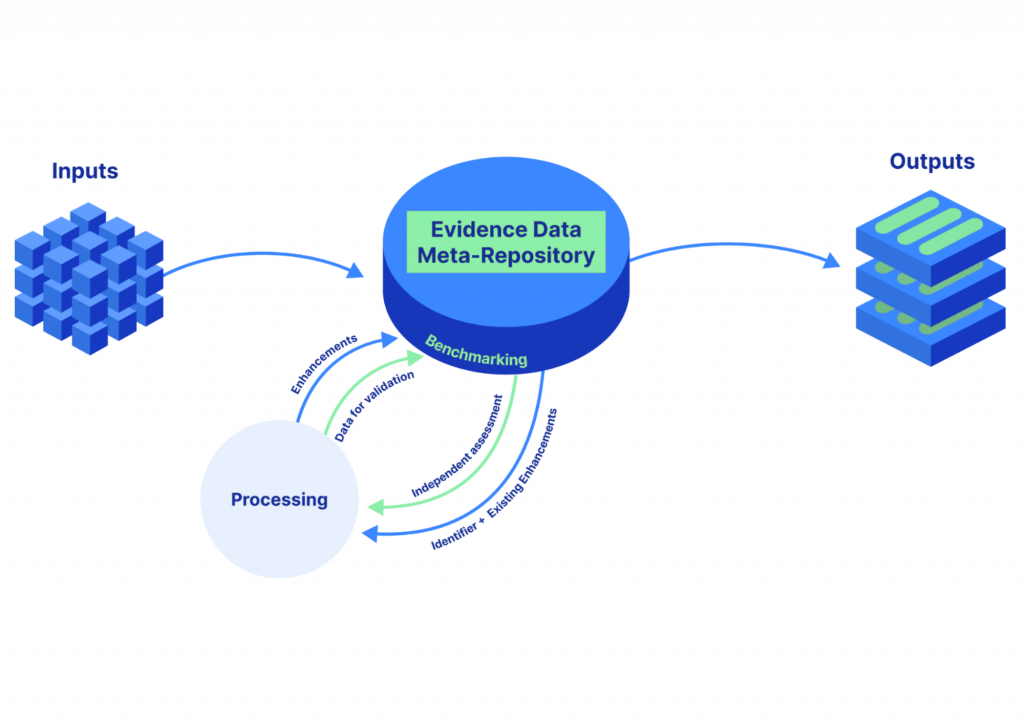
The open data infrastructure comprises, so far, the following elements:
Living evidence repository
DESTINY is developing open-source living evidence database software that continuously ingests new evidence from different data sources.
In DESTINY, we are applying this software to offer a repository containing the relevant scientific evidence in the field of climate and health, while related projects are using the same software to develop repositories of evidence on other topics.
The repository ingests evidence data from structured bibliographic databases such as OpenAlex, and will also ingest evidence from a variety of less structured “grey literature” sources.
Always up-to-date
New publications relevant to the topic of the repository (in DESTINY’s case, climate and health) are identified by the inclusion robot. New records are automatically checked and augmented with missing information (“get-the” robots) and further enriched (enhancement robots) according to the repository taxonomy.
Human-curated data
Open data standards allow interoperability with existing evidence synthesis tools that can retrieve data from the repository and are expected to hand back human-curated data in exchange.
User interfaces
Data from the living evidence repository is served to users through bespoke user interfaces (UI) and a variety of APIs (for example, bulk download).
DESTINY’s bespoke user interface for our climate and health repository, the agentic map builder, is an agentic AI tool that speeds up the process of building evidence gap maps while keeping a human expert in control of the key decisions.
Rigorous evaluation
DESTINY is also developing evidence synthesis applications that support the responsible application of AI-enhanced digital evidence synthesis tools.
The Data Extraction Evaluation Toolkit (DEET) is an open-source toolkit designed to support the development and evaluation of AI-assisted data extraction for evidence synthesis.
DEET provides an end-to-end, modular workflow for configuring, running and evaluating automated data extraction methods. It enables users to compare AI-generated outputs against human-created reference (gold standard) datasets, helping to assess the accuracy, consistency and performance of different approaches.
Designed around open and FAIR (Findable, Accessible, Interoperable and Reusable) principles, DEET supports reproducible evaluation through reusable code, APIs and standardised data models.